Central African Republic, commonly known as Central Africa, is a country located in Central Africa. As a landlocked As a country, Central Africa is in a clockwise direction from the west, bordering Cameroon, Chad, Sudan, South Sudan, the Democratic Republic of the Congo, and the Republic of Congo. Central Africa was established in December 1958. It was a semi-autonomous government at the beginning. Independence was officially declared on August 13, 1960. The capital Bangui is located in the border city along the Oubangui River.
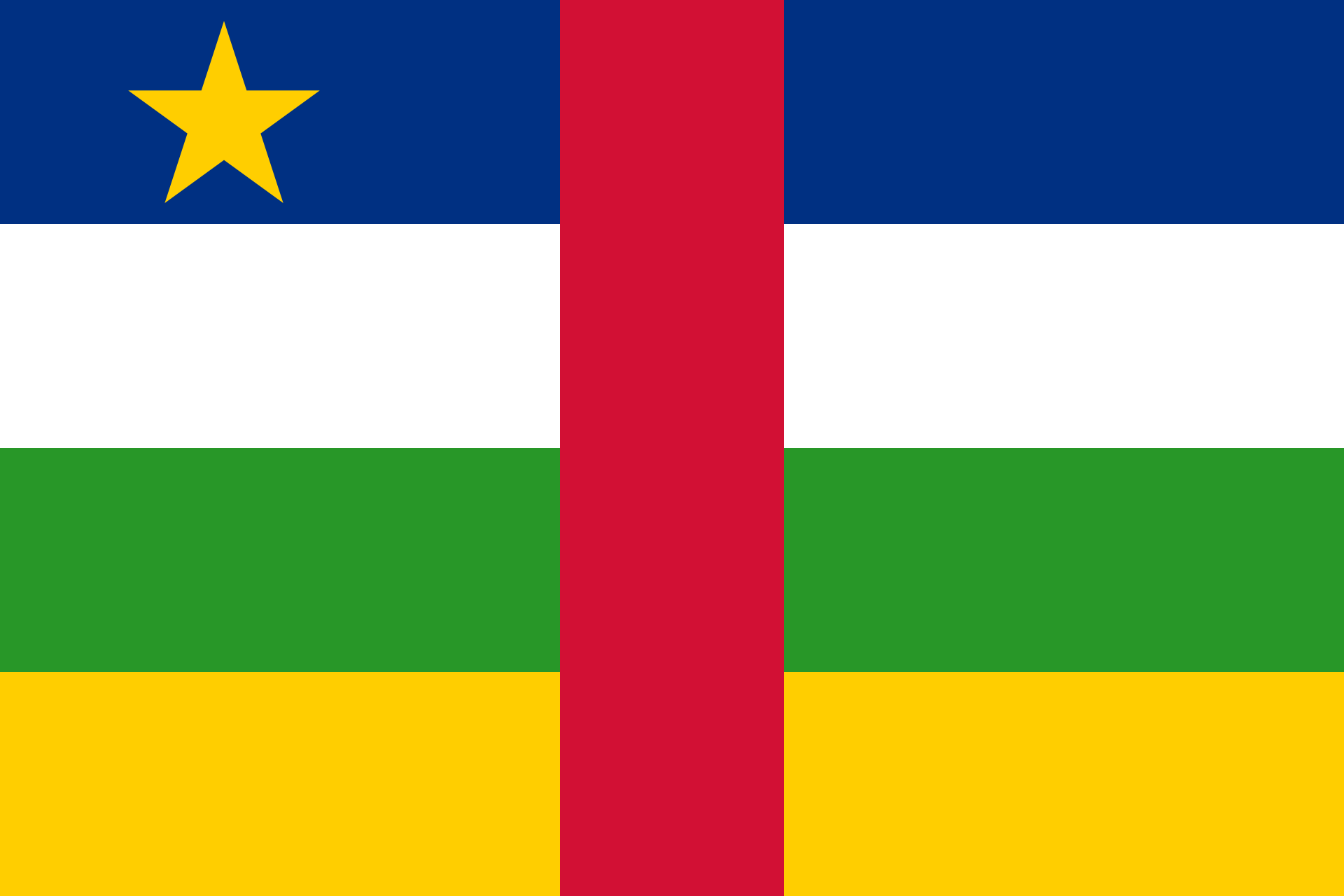
Flag (Flag of Central African Republic)
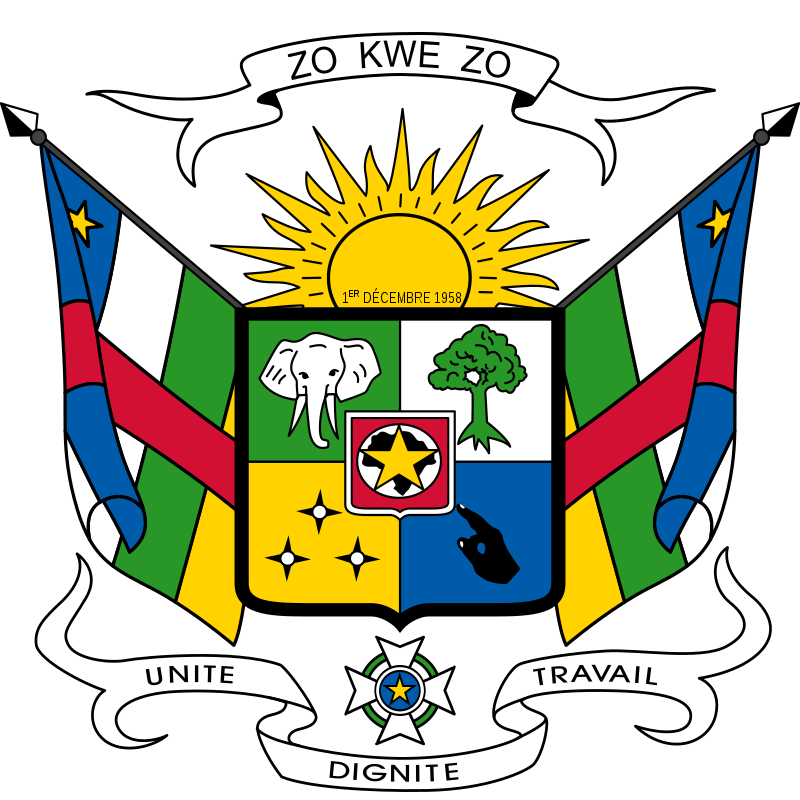
Emblem (National Emblem)
🎵 Anthem (Instrumental)
🎤 Anthem (Vocal)
O Central Africa, cradle of the Bantu!
Take up again your right to respect, to life!
Long subjugated, long scorned by all,
But from today breaking tyranny's hold.
Through work, order and dignity
You reconquer your rights, your unity,
And to take this new step
The voice of our ancestors calls us.
Chorus:
To raise the flag of the fatherland,
Brandishing the emblem of the nation,
Let us salute the fatherland,
Let us sing for the Central African rebirth!
Ô Centrafrique, ô berceau des Bantous !
Reprends ton droit au respect, à la vie !
Longtemps soumis, longtemps brimé par tous,
Mais de ce jour brisant la tyrannie.
Dans le travail, l'ordre et la dignité,
Tu reconquiers ton droit, ton unité,
Et pour prendre ce nouveau pas
La voix de nos ancêtres nous appelle.
Refrain :
Pour brandir l'étendard de la Patrie,
En avant du progrès et du bonheur,
Saluons la Patrie,
Chantons la Renaissance Centrafricaine !
Central African Republic
Report ErrorIntroduction
About the National Anthem
The Rebirth-'Renaissance'-La Renaissance < br>
'Renaissance' is the national anthem of the Central African Republic. It was adopted when the Central African Republic became independent in 1960. The text was written by the then Prime Minister Barthélémy Boganda. The music was written by a French composer. Created by Herbert Pepper, he also composed the Senegalese national anthem 'Pincez Tous vos Koras, Frappez les Balafons'. This song is also the national anthem of the Central African Empire.
'Renaissance' is the national anthem of the Central African Republic. It was adopted when the Central African Republic became independent in 1960. The text was written by the then Prime Minister Barthélémy Boganda. The music was written by a French composer. Created by Herbert Pepper, he also composed the Senegalese national anthem 'Pincez Tous vos Koras, Frappez les Balafons'. This song is also the national anthem of the Central African Empire.
Flag Meaning
(Details not available yet)
Emblem Meaning
The central pattern of the National Emblem of the Central African Republic is a shield emblem, and the small middle shield symbolizes the position of the Central African Republic in Africa; four quadrants They are the elephant head, the big tree, the diamond and the black hand (the symbol of the 'Black African Social Evolution Movement' of the ruling party at the time of independence). There are national flags on the left and right. There is a rising sun above (the date on the sun is December 1, 1958) The day of the establishment of the 'Autonomous Republic') and the ribbon of 'Everyone is equal in the world' written in Sango. The national motto 'Unity, Dignity, and Diligence' and the Maltese Cross are written in French on the lower ribbon.
🔗 External Resources & Travel Guide
- 📖 Wikipedia: Central African Republic - History, politics, and geography
- 📊 CIA World Factbook: Central African Republic - Official government statistics & maps
- ✈️ Wikivoyage: Central African Republic - Travel guide, attractions, and transport